2008-10-21


 All I wanna do is blog

A few weeks ago I saw this over at the BBC. I thought it was a little out of place for Powell, but what really struck me was this:
"It took a lot of people struggling to bring me to this point in history," Powell told the audience. "I didn't just drop out of the sky. People came from my continent in chains."


I thought, he's getting ready to endorse Obama. Of course, I didn't post that because, come on, how silly can you get? But, lo and behold, I wasn't alone.

The moral of the story: if you want to get ahead in the blogosphere, you gotta post every silly little idea that comes to your head. Otherwise, you'll never stand out from the plebitude. So, callous and stupid aside, let me say that getting Obama's white grandmother in the spotlight two weeks before the election is just what Obama needs to overcome the Angry Black Mack Truck hurling towards us. In the next ten days we are going to see a barrage of Rev. Wright's greatest hits. The McCain camp is getting us ready, since they have no choice but to respond what with Obama's negative campaigning. Any images of Obama's Kansas born and bred grandma will do wonders.


 The worse it gets, the better it gets. Pt II

Fareed Zakaria on the Colbert Report celebrates the upside of the economic crisis: America will start saving again. And yet all I hear about is lowering interest rates.

2008-10-20


 Christopher refuses to agree he's wrong


I love that Hitchens is willing to go on bloggingheads with Alterman to debate if he was wrong. Although, as he says, "at least the subject is me." Many of the comments on this seem to follow the lines of, I agree with Alterman, but just really like Hitchens. Likable isn't a descriptive I would associate with Hitchens, but I guess he inspires sycophantism.

For the record, Macedonia is Greek.

2008-10-19


 Amor y Cohetes


I remember as a teen Love and Rockets was one of the few (the only?) places I felt at home. Young chicano punk/goth rockers surrounded by Spanglish, mechanics, wrestlers, and dinosaurs, permeated with an unexpressed left-working class sensibility I remembered from DF. Like seeing a young punk walk from car to car in the Metro selling copies of El Machete with the same twangy sing-song as the kids selling chiclets.


Makes sense that Hopey and Maggie are now in their forties. They must have been in their twenties when I was reading their exploits, and I could only fantasize about living on my own with a poster of Ape Sex on the wall, but I'm glad they're still around.

I came across Love & Rockets searching for an article I read today lamenting the dearth of foreign literature translated into English.
330 works of foreign literature — or a little more than 2 percent of the estimated total of 15,000 titles released — have been published in the United States so far this year.

That apparent dearth of literature in translation in the United States was the subject of controversial remarks by Horace Engdahl, the permanent secretary of the Swedish Academy, the organization that awards the Nobel Prize, a week before the prize did not go to an American.

“The U.S. is too isolated, too insular,” Mr. Engdahl said in an interview with The Associated Press. “They don’t translate enough and don’t really participate in the big dialogue of literature.”

It has been a long time since I have seriously participated in the big dialogue of literature, about as long since I have read Love & Rockets. I have the collected works of Saramago, in Spanish, stacked on my shelves. Better get cracking.

2008-10-18


 Every time I post a little angel cries

It's not quite dogs with bees in their mouth and when they bark they shoot bees at you, nor is it a shark riding on an elephant's back, just trampling and eating everything they see, but damn, this fills me with an odd mixture of pity, fear, and revulsion nonetheless.

2008-10-17


 Meta Voco

Melanie Phillips at the Spectator is getting flak from PZ Myers and others for asserting that the financial crisis is rooted in the rise of militant atheism. It seems she feels that atheism somehow leads to an ethical deficit in capitalism.
I see this financial breakdown, moreover, as being not merely a moral crisis but the monetary expression of the broader degradation of our values – the erosion of duty and responsibility to others in favour of instant gratification, unlimited demands repackaged as ‘rights’ and the loss of self-discipline. And the root cause of that erosion is ‘militant atheism’ which, in junking religion, has destroyed our sense of anything beyond our material selves and the here and now and, through such hyper-individualism, paved the way for the onslaught on bedrock moral values expressed through such things as family breakdown and mass fatherlessness, educational collapse, widespread incivility, unprecedented levels of near psychopathic violent crime, epidemic drunkenness and drug abuse, the repudiation of all authority, the moral inversion of victim culture, the destruction of truth and objectivity and a corresponding rise in credulousness in the face of lies and propaganda -- and intimidation and bullying to drive this agenda into public policy.

The financial crisis was brought about essentially by a public which threw away all notions of prudence and committed itself to spending today what it could never afford to pay back tomorrow, and a banking, regulatory and political sector which ruthlessly and cynically exploited and encouraged such catastrophic irresponsibility with a criminal disregard of the ruinous consequences for the poor. The financial crisis and our social meltdown are thus combining to form a perfect cultural storm.

The assertion about militant atheism seems silly and patently false, but I think intelligent people can agree on the relatively recent rise of secularism. I would argue that it is capitalism leads to the rise of secularism as well as the breakdown of morals that Phillips laments. (And does this not fit the essence of Weber's Spirit of Capitalism: Protestant Ethic->Capitalism->Secular Work Ethic, as well as classic Marxian analysis?)

So, my question is, can either Phillips' or my position be falsified, or are both views solely a reflection of ideological stance? I'm having trouble seeing what kind of evidence would answer this question, although the depth of religious fervor in this country seems like a strike against my position.

2008-10-16


 The Dems' to lose

I was really curious to see if voters would overcome bias and vote for Obama. Unfortunately, we will never know. The Democrats could run a dead mule and they would beat McCain.

Anti-Obama focus groups are giving Republican strategists fits:
"Well, I don't know much about this terrorist group Barack used to be in with that Weather guy but I'm sick of paying for health insurance at work and that's why I'm supporting Barack."

"I'm gonna hate him the minute I vote for him. He's gonna be a bad president. But I won't ever vote for another god-damn Republican. I want the government to take over all of Wall Street and bankers and the car companies and Wal-Mart run this county like we used to when Reagan was President."

2008-10-15


 Gee whiz!

One of my SMS ladybugs overheard the following:
M: Buckley lost his job at National Review.
D: So he's not granfathered in? Think he saw that coming? Will the zeitgeist finally lead to a reorganization of conservative movement?
M: I think he just saw the sales potential in a "Saul on the road to Damascus" type autobiography at a time when his movement has lost its mojo.
D: Beautiful. I can see Papa grinning now.

Arteriosclerotic orthodoxy?


 The Big Five

I just took Jesse Graham and Jonathan Haidt's "Moral Foundations Questionnaire" at yourmorals.org . I recommend it. Turns out I'm a lot more conservative than I thought when it comes to Loyalty and Authority, although more liberal when it comes to questions of Fairness. A little concerned about the Authority finding, but fine with all the rest. I guess I'm on the fence when it comes to Purity, and not doing Harm. My results are in green.

Here's the authors' description of the survey and results:
The scale is a measure of your reliance on and endorsement of five psychological foundations of morality that seem to be found across cultures. Each of the two parts of the scale contained four questions related to each foundation: 1) harm/care, 2) fairness/reciprocity (including issues of rights), 3) ingroup/loyalty, 4) authority/respect, and 5) purity/sanctity.

The idea behind the scale is that human morality is the result of biological and cultural evolutionary processes that made human beings very sensitive to many different (and often competing) issues. Some of these issues are about treating other individuals well (the first two foundations - harm and fairness). Other issues are about how to be a good member of a group or supporter of social order and tradition (the last three foundations). Haidt and Graham have found that political liberals generally place a higher value on the first two foundations; they are very concerned about issues of harm and fairness (including issues of inequality and exploitation). Political conservatives care about harm and fairness too, but they generally score slightly lower on those scale items. The big difference between liberals and conservatives seems to be that conservatives score slightly higher on the ingroup/loyalty foundation, and much higher on the authority/respect and purity/sanctity foundations.

This difference seems to explain many of the most contentious issues in the culture war. For example, liberals support legalizing gay marriage (to be fair and compassionate), whereas many conservatives are reluctant to change the nature of marriage and the family, basic building blocks of society. Conservatives are more likely to favor practices that increase order and respect (e.g., spanking, mandatory pledge of allegiance), whereas liberals often oppose these practices as being violent or coercive.

In the graph below, your scores on each foundation are shown in green. The scores of all liberals who have taken it on our site are shown in blue, and the scores of all conservatives are shown in red. Scores run from 0 (the lowest possible score, you completely reject that foundation) to 5 (the highest possible score, you very strongly endorse that foundation and build much of your morality on top of it).


You can download the pdf of Haidt and Graham's article, and take the survey yourself. Registration required.

Haidt, J., & Graham, J. (2007). When morality opposes justice: Conservatives have moral intuitions that liberals may not recognize. Social Justice Research, 20, p. 98-116

h/t to Roscoe for the link.

2008-10-14


 Wow

I'm speechless.
AFL-CIO joins the gun wars.


 Market rallies 900 points on Krugman Nobel


Spencer had a sobering take on the rally:
The market bounced back today to almost where it was on Wednesday.

But if you look at how the various sectors did the market is not only discounting that the bailout will work, but that it will be inflationary because the market bet on energy and raw materials today, not financials.

Moreover, the market is betting that the bailout wlll cause commodity prices to rise but not consumer spending..
this is an interesting forecast.

The headline is also his.

2008-10-13


 Go Philly Hockey Moms!


When Sarah Palin dropped the ceremonial first puck at the Flyers’ opener on Saturday night at the Wachovia Center, she was greeted by resounding (almost deafening) boos.

Have to agree with commenter number 5 that Palin was nuts for taking her daughter with her onto the ice in enemy territory.


 Is a hoax ever more than a hoax?

I missed this August post by Stanley Fish where he takes Alan Sokal to task. It's in the context of a recent hoax of Wine Spectator's restaurant awards. The bottom line, per Fish, is that for a hoax to be successful it has to be so elaborate that it demonstrates the hoaxer's bona-fides rather than anything intrinsic about the hoaxee. Many moons ago I wrote a critique of the entire issue of Social Text where Sokal's hoax was published and found that not all, but a few other entries in that journal could have easily been a hoax as well. I think Fish brushes aside the argument about standards a little too easily. Both hoaxes were conceived because the authors perceived an incredible lack of standards in the respective arenas: one, postmodern thought, the other foodie awards. The oracle of wiki asserts that Social Text was not a peer-reviewed journal at the time of the hoax, implying it now is. The editors at Social Text correctly note that peer-reviewed journals have also been the victims of outright fraud, and the hoax authors could have simply padded their CVs with their submissions and awards (just think of the amazing publicity for a newly opened Osteria L’Intrepido), but one hopes that these hoaxes have led to stricter standards, at least in the short term.

2008-10-12


 Mockrates is a math-challenged rat turd

Unlike his heart-throb Obama, I’m not afraid to use the same gutter tactics mock learned in his days as a member of the Nazi, er, Republican Youth. I would have called him a piece-of-shit, but felt it rude for a header. To be clear, I stand by my claims. Now, Mockrates is not literally a dropping of excreta from a sewer rat, but he will be in the not too distant future. And he has decided to channel his unavoidable future in the here and now. Always ahead of the curve, that mock.

The tortured piety of the “necessary first step”. Right, the necessary first step was to tackle a problem by screaming: CRISIS, CRISIS, CRISIS: IF YOU DON”T PASS THIS THE ECONOMY WILL COLLAPSE. Somehow, the “necessary first step” was to throw away a trillion dollars on a coin toss. The question: Will it solve anything? The answer: “I dunno, but gotta try somethin.” If past actions are any indication, the plan—or the absence of a plan—was to improve the bottom line for the fat cats. It was doomed to failure, and was advocated using the same parasitic gambling mentality that seeks to socialize risk and privatize the profit.

The right approach would have been to, as I advocated, take a deep breath and think of the best way to lessen the blows to the economy. Our “leaders” should have said, there is a crisis brewing, but we are working on crafting a strong solution to the problem. One, the markets would not have become destabilized by the clown show in Congress, and might have been settled by a strong effort to seek serious solutions. Paulson’s screams of PANIC, together with the Congressional bungling both made the economic crisis worse. Voting down a bad plan only to vote for a worse plan a few days later. Your claims that it was a necessary first step are ludicrous. It is the same as claiming that the necessary first step to a potential fire in a theatre is to scream FIRE and run for the exit. Maybe there is a fire, maybe there isn’t, but causing a stampede helps no one. And there are credible voices, even now, saying there is no fire. If this is true, our Bozo the President and Congress of Stooges caused the market instability we saw all last week. To argue that Congress couldn't have passed a better bill is a strong argument against passing any bailout bill.

I assume we won’t hear from Mockrates again for another few weeks. Just as well. This type of apologizing for negligent governmental action beneath a veneer of “learned earnestness” was part of the problem, not the solution. If the Krugmans of the world had put forward useful alternative proposals and joined in putting the screws on Congress, then they would have been forced to anger the Jewish G-d, stay in session, hold hearings, and work the time necessary to iron out an intelligent solution. The country was united in anger at the leadership in a way we rarely see. It truly was a lost opportunity.

2008-10-10


 Hitchens brings me back into the fold

From this month's Vanity Fair:

In a statement on the huge state-sponsored salvage of private bankruptcy that was first proposed last September, a group of Republican lawmakers, employing one of the very rudest words in their party’s thesaurus, described the proposed rescue of the busted finance and discredited credit sectors as “socialistic.” There was a sort of half-truth to what they said. But they would have been very much nearer the mark—and rather more ironic and revealing at their own expense—if they had completed the sentence and described the actual situation as what it is: “socialism for the rich and free enterprise for the rest.”

I have heard arguments about whether it was Milton Friedman or Gore Vidal who first came up with this apt summary of a collusion between the overweening state and certain favored monopolistic concerns, whereby the profits can be privatized and the debts conveniently socialized, but another term for the same system would be “banana republic.”

What are the main principles of a banana republic? A very salient one might be that it has a paper currency which is an international laughingstock: a definition that would immediately qualify today’s United States of America. We may snicker at the thriller from Wasilla, who got her first passport only last year, yet millions of once well-traveled Americans are now forced to ask if they can afford even the simplest overseas trip when their folding money is apparently issued by the Boardwalk press of Atlantic City. But still, the chief principle of banana-ism is that of kleptocracy, whereby those in positions of influence use their time in office to maximize their own gains, always ensuring that any shortfall is made up by those unfortunates whose daily life involves earning money rather than making it. At all costs, therefore, the one principle that must not operate is the principle of accountability. In fact, if possible, even the similar-sounding term (deriving from the same root) of accountancy must be jettisoned as well. Just listen to Christopher Cox, chairman of the Securities and Exchange Commission, as he explained how the legal guardians of fair and honest play had made those principles go away. On September 26, he announced that “the last six months have made it abundantly clear that voluntary regulation does not work.” Now listen to how he enlarges on this somewhat lame statement. It seems to him on reflection that “voluntary regulation”

[It] was fundamentally flawed from the beginning, because investment banks could opt in or out of supervision voluntarily. The fact that investment bank holding companies could withdraw from this voluntary supervision at their discretion diminished the perceived mandate of the program and weakened its effectiveness.


Yes, I think one might say that. Indeed, the “perceived mandate” of a parole program that allowed those enrolled in it to take off their ankle bracelets at any time they chose to leave the house might also have been open to the charge that it was self-contradictory and wired for its own self-destruction. But in banana-republicland, like Alice’s Wonderland, words tend to lose their meaning and to dissolve into the neutral, responsibility-free verbiage of a Cox.

And still, in so many words in the phrasing of the first bailout request to be placed before Congress, there appeared the brazen demand that, once passed, the “package” be subject to virtually no more Congressional supervision or oversight. This extraordinary proposal shows the utter contempt in which the deliberative bodies on Capitol Hill are held by the unelected and inscrutable financial panjandrums. But welcome to another aspect of banana-republicdom. In a banana republic, the members of the national legislature will be (a) largely for sale and (b) consulted only for ceremonial and rubber-stamp purposes some time after all the truly important decisions have already been made elsewhere.

I was very struck, as the liquefaction of a fantasy-based system proceeded, to read an observation by Professor Jeffrey A. Sonnenfeld, of the Yale School of Management. Referring to those who had demanded—successfully—to be indemnified by the customers and clients whose trust they had betrayed, the professor phrased it like this:

These are people who want to be rewarded as if they were entrepreneurs. But they aren’t. They didn’t have anything at risk.

That’s almost exactly right, except that they did have something at risk. What they put at risk, though, was other people’s money and other people’s property. How very agreeable it must be to sit at a table in a casino where nobody seems to lose, and to play with a big stack of chips furnished to you by other people, and to have the further assurance that, if anything should ever chance to go wrong, you yourself are guaranteed by the tax dollars of those whose money you are throwing about in the first place! It’s enough to make a cat laugh. These members of the “business community” are indeed not buccaneering and risk-taking innovators. They are instead, to quote my old friend Nicholas von Hoffman about another era, those who were standing around with tubas in their arms on the day it began to rain money. And then, when the rain of gold stopped and the wind changed, they were the only ones who didn’t feel the blast. Daniel Mudd and Richard Syron, the former bosses of Fannie Mae and Freddie Mac, have departed with $9.43 million in retirement benefits. I append no comment.


 Douchashov: Coward and Historical Revisionist

"You ask for a proactive proposal. In a word, socialism"

No, Douchashov, no one asked for your "proactive" proposal after the bailout failed to immediately garner all the results you believed it should have--we criticized you for not having one beforehand and then parading around afterwards, pretending you saw this coming. Oh, and "socialism" was the solution you knew would work, but were secreting away from us for some reason?

There's a curious lacuna in your thought process that one often sees in vulgar Marxists: Marx viewed fully-actualized capitalism as the necessary precursor to socialist revolution, though most revolutionaries would choke on that scientific interpretation because it clashes with the moral imperative for revolution (which is really why they're revolutionaries to begin with). Similarly, I have't the slightest idea how you thought a plan of flat out nationalization (which I favor) was even a remote possibility until other half measures (like the bailout) had been tried and failed.

"If the economic problem is truly fundamental, a govt. bailout won't solve it. And as we saw it can't even put a floor under it."

I'm not even sure what your hypothesis is about what's causing this crisis. At one point you say:

"The ideology of living beyond our means is why "faith" will not be restored."

Then you say

"Looking for a quick fix is the cause of the crisis. A nice start in getting on track would be punishing off-shoring and out-sourcing, and that could be done immediately."

Putting aside the fact that "punishing" off-shoring and outsourcing is immaterial and completely beyond the realm of possibility at the moment, you seem to be saying that the fundamental problem is that we spend much more than we make, or can hope to pay back within a reasonable span of time.

That's a great meta-critique of US consumerism and over-leveraging in the financial world, but if it is, in fact, the "fundamental cause" of the current crisis (recognizing how quickly this could become a bottomless semantic debate about the term "fundamental"), then surely what we need to be dealing with right now is the proximate cause, which is 1) the information assymetry, to put it mildy, created by the packaging up and securitizing of good and bad mortgages together, 2) the rapid decline in the property values underlying these mortgages, and 3) the seizing up of the credit markets based on the uncertainty created by 1) and 2).

The credit market problems are beginning to have a huge impact on employment--surely you aren't suggesting that we need to sign the country up for behavior modification shock treatment before we attempt to address that. If you are, then I say to you and all the libertarians fulminating about this on the margins: I understand what an important role punishment and pain play in your psycho-sexual constitution, but this really isn't the place to actualize your fantasy lives.

This is going to be a progressive process of varying levels of government intervention, and it had to begin with the highly-flawed bailout that was, by definition, the one that was politically possible at the time. Doing nothing was not a political option--most of the Republican and Democrat no votes the first time around knew that, but felt free to vote against it because they thought there were enough votes to pass it without them.

Republicans were especially loathe to be seen supporting it because it's exactly the type of issue they specialize in demagoguing: one with a complex interplay of costs and benefits that is difficult to explain even in the time allotted on the Jim Lehrer News Hour.

"You're first mistake was in assuming that the bailout was being considered in the best interest of the country."

Which of us thought that? Your first mistake was making the best the enemy of the good (and by "good" I of course mean the necessary first step). Although, then again, you didn't really even do that, did you, as that would have required making a concrete suggestion without the benefit of your retrospectacles.

Now it appears, as you noted, that straight out nationalizations are being considered. That could only have happened once the more moderate options had been tried. Anyone who thinks otherwise is fooling his socialist self.


 Mavericks for Ayers

Two thousand plus mavericks and counting. I love how the focus is on the character assassination of Ayers, and not Obama. I wish it discussed the actual accusations against Ayers, but I suppose the aim was to appeal to a wider demographic.


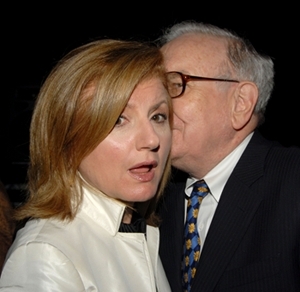
 Buffet prepares to lay some pipe


Huffington Post is inviting readers to caption this pic. Another reason to love the Huff Post.


 So pocketbook trumps race?

This month's Labor Notes has a good piece on race and the election.
Labor leaders who want desperately to chase the Republicans from the White House are confronting a hurdle in their outreach to members: the question of race. Obama’s record on economic issues, they say, should put him way ahead of John McCain with working-class voters. But will the facts be enough to overcome some members’ deep-seated prejudice?

“We have people disguise it by saying he doesn’t have enough experience, or they’re not comfortable voting for him,” says Kyle McDermott, field director in the Steelworkers’ political department. “And we have people come at us and say, ‘Look, I’m not going to vote for a black person.’ They don’t use as kind words as I just did.” . . .

A September 8-10 national poll of likely voters by Democracy Corps found that in white union households, Obama gets 44 percent of the vote, 8 points below the local Democratic candidate for Congress and 9 points below the number of those who identify as Democrats. In 2004 white union households backed John Kerry by a 52.4 percent margin.

Putting aside people voting against their own interests, I had this pit of dread in my belly about Obama losing due to race. But now that pit's been replaced by a well of nausea due to the economy. It's striking how economic uncertainty has pushed unease about race off the table.

Now union members, military families, and other stereotypes in states as diverse as Michigan and Virginia are turning hard for Obama. A few weeks ago 527's were running race-baiting ads in Macomb county in Detroit suburbs, and now McCain pulls out of Michigan.

But what does this say about race relations? Does this mean that in bad times a visceral response to race doesn't matter, but in good times it does?

2008-10-07


 I was against it, before I was for it

Here's Paul Krugman on Rachel Maddow's show bemoaning the failure of the bailout. He was one of the morons arguing the bailout MUST be passed. Now he's saying the bill was a terrible idea, time to go back to the drawing board . . . Ooh! He's angry! (Must be all that egg on his face.)

That trillion would have come in handy right about now.